Professional services firms operate in environments where accuracy, judgement, compliance and expertise are critical. Traditional learning models: static courses, annual training cycles and disconnected knowledge libraries, often struggle to keep pace with the complexity and speed of modern advisory work. This has led to the rise of agentic AI learning platforms, designed to support professionals continuously, contextually and responsibly.
So what is an agentic AI learning platform used for in professional services, and why is it different from conventional learning systems?
Moving beyond static learning
In professional services, learning cannot be separated from doing the work. Professionals must apply technical knowledge, ethical judgement and organisational standards in real time. Agentic AI learning platforms are built for this reality, embedding learning directly into daily workflows rather than treating it as a separate activity.
Instead of searching through static content libraries, users are guided through learning and decision-making as part of their work. Learning becomes embedded, responsive and ongoing, not scheduled or siloed.
Supporting work in the flow of practice
A core use of an agentic AI learning platform is providing just-in-time guidance. Professionals can ask questions as they arise, clarify uncertainty and explore how standards or frameworks apply to specific scenarios.
This allows learning to happen:
- During client or advisory work
- At the point of uncertainty
- In response to real situations
By supporting learning in the flow of work, these platforms help professionals maintain momentum while improving confidence and quality.
Turning learning into action
What makes these platforms “agentic” is their ability to guide action, not just provide information. They can prompt next steps, sequence learning logically and reinforce expectations around quality, ethics and governance. This shifts learning from passive consumption to practical capability building, where knowledge is consistently applied.
The user-facing experience of an agentic AI platform: Luca Learning
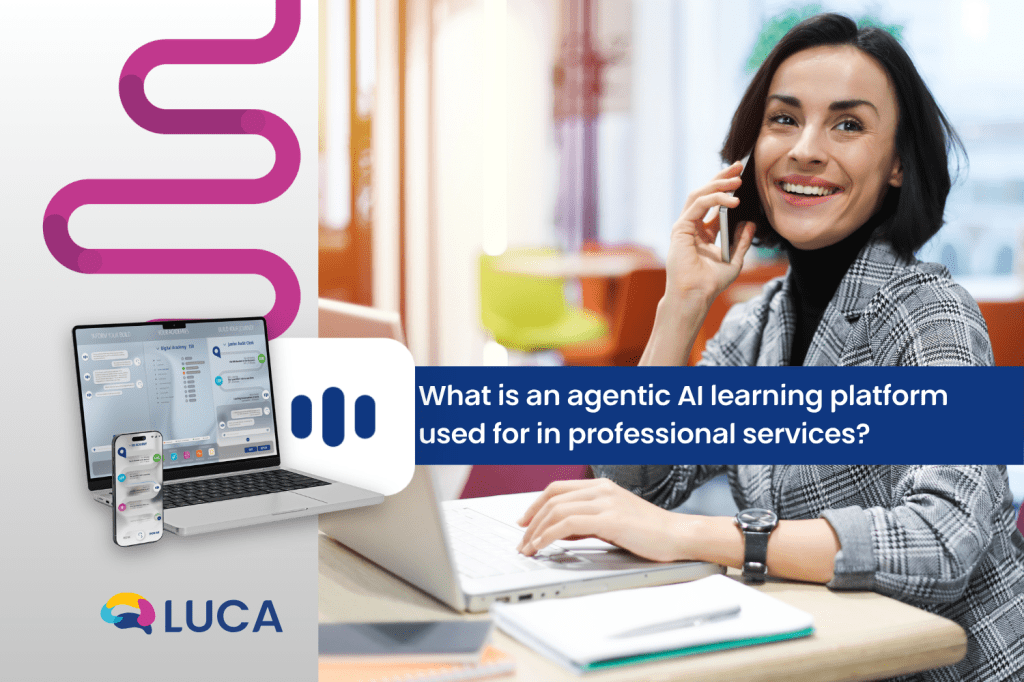
The user-facing experience of an agentic AI learning platform is where its value becomes tangible. This experience is delivered to staff through Luca Learning powered by Superworker, which is structured around two core elements: Show Me and Ask Me.
Show Me provides guided, role relevant learning journeys and prompts, helping users understand what they need to do next and how learning fits into their work. Ask Me is a chat-based experience that allows users to ask questions in plain language and receive contextual guidance in real time.
Together, these elements support both structured development and in the moment learning. Luca Learning includes a conversational chat feature and is available via the Apple App Store, Google Play Store, as well as on desktop and mobile, making it accessible wherever professionals work.
Personalised, role-based development
Agentic AI learning platforms are used to deliver role-aware learning, adapting guidance based on role, experience level and professional requirements. This ensures learning remains relevant, practical and aligned to how different professionals actually work.
Reinforcing quality and governance
In regulated environments, these platforms help reinforce quality and risk management by embedding approved knowledge, frameworks and guardrails. They support consistent decision-making while preserving professional judgement, acting as a trusted first line of guidance rather than a replacement for expertise.
A new model for professional learning
Ultimately, agentic AI learning platforms are used to connect knowledge, guidance and action. They transform learning from a periodic obligation into an everyday capability, helping professionals do their work well, make better decisions and continue developing with confidence.


Leave a Reply